Contact
contact@ivoschmetz.nl


After a collaboration of 20 years, I started fresh in 2023. This time on my own and under my own name. Starting over means redefining who you are and what you do. In my case, that is not so simple, because I enjoy many different things and am actively involved in various roles and activities. I am a graphic designer, but also a video editor, animator, initiator, web documentary maker, interaction designer, activist, writer, music programmer, board member, curator, publisher, and for some time now I have also been giving presentations and workshops. That sounds like a lot and perhaps unbelievable, but this is who I am and what I do.

This multidisciplinary character developed over time because I often take the initiative to set up projects and enjoy experimenting with different media and art forms. Some people see this multidisciplinary approach as unclear and confusing, but I see it primarily as a strength. It is a hybrid form of being a designer in which I connect different genres, activities, media, initiatives, art forms, and activism in order to work toward new perspectives and ideas.

As we all know, the world is not doing very well. There are many crises, conflicts, and divisions. Our society (or societies) are under pressure, and non-human life on Earth is suffering greatly as a result of human actions. I deliberately call it “human action,” because it is abundantly clear that our desires, our runaway consumer society, and our drive for infinite growth and profit maximization are the root causes of many problems. We want more than is possible, and that affects our lives, but especially those of non-human life and future generations.

This awareness plays a major role in defining who I am and what I want to do. I no longer want to work (or contribute) to making products and services more attractive or adding value to things that cause or contribute to the many crises facing humanity and the Earth. I do not want to tell my children and grandchildren one day that I was too cowardly to change, or that I knowingly continued doing something I knew was no longer viable, purely for the money.

I understand that you cannot simply withdraw from this system, and it would be hypocritical to claim that I do everything right. I don’t, and that is impossible anyway. What I do try to do is think carefully about the role my work plays in and for society. I work from a clear, content-driven motivation and try to bring others along in raising awareness and in the transition toward something new.

For that transition, we need a government that is committed to a just society and a healthy planet, rather than one that is narrowly focused on the economy. We need companies that operate within the planetary boundaries and do so in a fair way for everyone. And we need people who organize themselves around the commons and cooperative principles, encouraging governments and businesses to act from intentions that align with our responsibility to leave the Earth in a healthy state. We can do this—and we must.

I want to work for and with people, organizations, governments, and companies whose mission aligns with this intention to do everything possible to make life better, healthier, and fairer for everyone, including non-human life on Earth. It will not happen overnight, but I am convinced that together we can create a new collective vision of the future. A new narrative in which we no longer measure success, freedom, and happiness by how much money and power we have to satisfy all our needs, but by things that truly matter.

How did I get to where I am now?

OLVG
After a fantastic time at the art academy in Maastricht, I moved to Amsterdam in 1997. I started working at a video company and fairly quickly (by coincidence) ended up in the squatting scene. In 1998, I helped squat two wings of the OLVG hospital in Amsterdam East. I used one of the many rooms as a studio and turned another into living space. As a growing group of people made the building increasingly livable, we also began organizing exhibitions and parties.
It was a fairly well-organized happy chaos that I will never forget, but unfortunately, after about a year and a half we were evicted and had to look for a new building.

OT301
A few months after the eviction, on November 14, 1999, the OT301 (the former film academy of Amsterdam) was squatted. Slightly smaller than the hospital, but still a fantastic building with many possibilities to continue the combination of living, working, and public functions that we had started at the OLVG.
In 2006, we succeeded as a collective of artists and creatives in purchasing the building from the municipality and converting it into collective ownership. In this case, collective ownership means that the property always belongs to the association and not to individuals within the collective. No one can sell their share.
The purchase was an important moment for the survival of OT301, but also for me personally. I became increasingly interested and involved in the organizational structure. I became music programmer for our concert/club space and joined the board of the association in 2011.
As a member of the PR & communications committee, I designed many flyers, posters, banners, and the OT301 website. Together with others, I also produced the books Autonomy Through Dissent (2013) and 20 Years of Art & Autonomy (2019).
I am still active at OT301 as a music programmer and board member. Since early 2023, together with a team of volunteers from Amsterdam Alternative, I have also been responsible for the programming of the cinema on the second floor of the building.

3-1
When the software ReBirth RB-338 was released in 1996, I came into contact with making music for the first time. In my student room in Maastricht, I often spent nights experimenting with beats and synths on my computer. I knew little to nothing about making music and worked purely from intuition and feeling. It was a proces of listening, trying, listening, trying... for hours on end, almost in a trance.
In the squatted OLVG hospital in Amsterdam East, music-making became more serious, and together with Peter Rutten I founded the electropunk band 3-1. In the beginning, we made rather abstract, vague, unpredictable noise, but as we learned more, our tracks became more structured and refined. To emphasize the raw character of the music, we bombarded audiences during live performances with homemade videos and an absurdist live show featuring dancers and a kickboxer.
We played as 3-1 until 2010, performing hundreds of live shows at festivals, museums, clubs, and squats in the Netherlands and abroad. After 3-1 ended, I worked with Peter and Paul on a new project called TCS, but due to lack of time we did not continue it for long. In 2016, Peter and I started making music again under the name Van Pi, and later with Lilian Hak under the name LHISPR.

310k
After several self-initiated projects and some VJ performances, Paul Rickus and I officially started the design studio 310k in April 2003. In addition to the usual print assignments of the time — such as posters, flyers, record covers, visual identities (logo, letterhead, business cards), magazines, and books — we had a strongly multidisciplinary approach from the beginning. We especially liked working on projects that combined print with online and video content.
During the twenty years we worked together under the name 310k, we handled a wide range of cultural and commercial commissions. It was a wonderful period in which we learned a lot, realized many of our ambitions, and had a great deal of fun. As we always called it ourselves, 310k was pure magik (with a k). In 2023, after exactly twenty years of collaboration, we decided to stop. Time for something new — a new direction, new goals, and new ambitions. We still share a studio, but now each of us works under our own name.

Basserk
At the end of 2005, Peter Rutten, Paul Rickus, and I decided to release the music of our electropunk band 3-1 on our own record label, Basserk Records. Our first EP, Don’t Destroy, was pressed on vinyl in an edition of 500 copies. To our surprise, all the records sold fairly quickly. Encouraged by this, more releases soon followed.
We started with electropunk and electro, but soon decided to release music in other genres as well — ranging from electro and techno to ambient, bass, future beats, breaks, and more. We did not want to limit ourselves to a single genre, as long as the music was raw and energetic.
Despite some small successes and the potential to make something “big” out of it, Basserk is and remains a “small” label. Unfortunately, we do not have the time or resources to scale it up. Basserk still exists because we love music and enjoy helping young, talented artists find their way.

Abnormal Data Processing
Abnormal Data Processing is a small, independent publishing house that I founded in 2011 to publish self-initiated projects, both independently and in collaboration. As a graphic designer, I have always had a love for books and special print work. The digital world is of course fantastic, with all its multimedia and interactive possibilities and its wide reach, but it lacks the physical element.
The beauty of print lies in the details: the choice of paper, format, binding, printing technique, ink, cover, and, of course, the design. The physical aspect — and even the smell of freshly printed material — still makes “old-fashioned” printing very worthwhile.

Amsterdam Alternative
Amsterdam Alternative emerged in the spring of 2015 as a collective of non-commercial (sub)cultural free spaces in Amsterdam. Our initial goal was to establish a new, supportive network to connect the remaining free spaces in the city and help them when needed.
After several meetings, I proposed — as a graphic designer — the idea of creating a free newspaper together, in which we could share both our programming and background articles to strengthen the voice of the underground.
In addition to the newspaper, we also organize public discussions, documentary and film screenings, the AADE, podcast recordings, and the AA Academy, together with a large group of volunteers. These activities take place at various locations in the city, but since early 2023 mainly at the Ventilator cinema/bar in OT301.
To help realize new free spaces in Amsterdam, we initiated Vrij Beton and later created an extensive modular web documentary on collective ownership. As one of the co-founders, I am still closely involved in Amsterdam Alternative — not only as the designer of the newspaper, website, events, Vrij Beton, and the web documentary, but also as a coordinator, connector, and driving force.

Writing
I no longer remember exactly when or why, but my love for stories and books has been with me since my early years. This fascination with the printed book is twofold. On the one hand, there is the designer in me who loves the craft of bookmaking — the form, paper, ink, binding, and the physical experience of a book. On the other hand, there is the content: the story. Words take you on adventures, provide insights, spark interest, and largely shape how others think about something or someone. Our society is, to a large extent, built on stories.
The urge to write only emerged at art school, but the things I wrote there never saw the light of day. My book Archivo De Pivo (2011) contains my first writings, but they are entirely subordinate to the visual character of the book. It was only when I co-founded Amsterdam Alternative in 2015 and started working on the newspaper that I decided to write seriously for publication. I have since written many articles and do so with great pleasure, while also realizing that I still have much to learn.

Vrij Beton
In January 2019, during a public discussion at the Vrijpaleis, we launched a plan under the banner of Amsterdam Alternative to fight for new free spaces — permanent free spaces in collective ownership. The then-unnamed project was enthusiastically received and was given the name “Vrij Beton” a few months later.
The project continues to be received with great enthusiasm, but to this day we have not yet succeeded in realizing the first Vrij Beton free space in Amsterdam. This is not surprising, as acquiring property or space is extremely difficult in a city where space is scarce and prices are extremely high.

Web Documentary
After an online and offline campaign to introduce Vrij Beton to a broad audience, I organized several public discussions to involve interested and curious people in this ambitious project. I quickly noticed that many people had little understanding of how collective ownership works and often confused it with communism.
Instead of stubbornly continuing with Vrij Beton, I decided to take a step back and first create a foundation in the form of an archive or knowledge base — a place I could refer people to when it became clear they lacked knowledge about collective ownership. Because there are so many inspiring stories and examples, I decided to turn it into an modular web documentary: a project in which video, audio, photography, and text are combined to bundle knowledge and make it freely available to a wide audience. The web documentary has been online since early 2024 at www.collectiveownership.net.

Workshops and Presentations
The alternation between different projects and roles is challenging and gives me a great deal of satisfaction and energy. This hybrid form has developed over time because I have always combined my design practice with self-initiated, autonomous projects and collective, non-commercial initiatives such as OT301, Amsterdam Alternative, Vrij Beton, and the web documentary on collective ownership.
Because of this diversity of activities, I am not only an experienced designer and maker, but also have extensive experience organizing within collective, horizontal structures. In recent years, I have regularly shared my knowledge and experience through presentations, lectures, and workshops. Depending on the location, theme, and setting, I speak about topics such as design and creativity, free spaces, self-organization, self-management, taking initiative, collectivity, entrepreneurship, solidarity, activism, and collective ownership. I tailor the content of each presentation or workshop to the desired focus.

Future
I do not know exactly what the future will bring, but I hope to continue designing, organizing, initiating, writing, and doing all the other things I enjoy for a long time to come. I hope there will be many more meaningful self-initiated projects, collaborations, and commissions. At the same time, I want to keep experimenting, learning, and reflecting on the role of my work within the larger whole.
The role of the designer who makes something look beautiful when what lies behind the façade is ugly or harmful is certainly not mine. I only want to work for organizations, brands, companies, and people who think beyond their own wallets and are willing to commit themselves to a hopeful, healthy, and just future for everyone.


Design studio

Graphic design, interaction design, video, animation…
After graduating from the art academy in Maastricht in 1997, I moved to Amsterdam to start working as a designer. After gaining several years of experience as a designer and video maker — among others at Solar Initiative — I co-founded the multidisciplinary design studio 310k in 2003 together with Paul Rickus. For 20 years, we collaborated with great pleasure and success on a wide range of commercial and cultural commissions. In 2023, we decided to stop working under the name 310k and each go our own way.
I am available as a graphic designer, video maker, interaction designer, and animator for both large and small projects. I prefer to work for and with people who want to create something meaningful together, while prioritizing the challenges of our time and a healthy, livable planet for future generations.

Web documentary Sinking Cities

Sinking Cities is a multimedia web documentary about land subsidence—a relatively unknown issue that causes problems worldwide. Commissioned by (and in collaboration with) journalist Stephanie Bakker and photographer Cynthia Boll, I designed this web documentary and produced a large part of the videos.

Twenty percent of cities worldwide are sinking, affecting one fifth of the global population. While sea level rise receives most of the attention, land subsidence often goes unnoticed. As a result, cities become vulnerable to flooding, buildings and infrastructure are damaged, and nature and biodiversity are affected.

How can we adapt to a changing climate? Not only by focusing on technical solutions and efficient spatial planning, but also by considering the culture and tangible and intangible heritage shaped by the same water that now threatens these cities.

Photographer Cynthia Boll and journalist Stephanie Bakker traveled to these sinking cities. They started in Jakarta, Gouda, and Venice—three water cities on the frontline of climate change.
Through powerful imagery and personal stories from cities around the world, Boll and Bakker reveal the human side of this complex, invisible problem. They show what is at stake - and what is still possible.

In the coming years, the web documentary will be further expanded.
View the web documentary at www.sinking-cities.nl
The Sinking Cities logo has been made by Kummer and Herrman


Plein Theater

Plein Theater is a theatre in Amsterdam East with a contemporary, interdisciplinary, and diverse programme for children, young people, and adults. It is an internationally oriented theatre that also serves as a springboard for young local talent.

In 2019–2020, I designed the new visual identity for Plein Theater, including a series of flyers, posters, and a brand-new website. After five years of intensive use, the website was ready for an update, and in 2025 I was invited to design a new one.

Like the previous site, this website is connected to Amsterdam Alternative, so programme listings are published simultaneously on both platforms.
To capture the atmosphere of Plein Theater, I teamed up with Pablo van Wetten (camera) to create a video featuring various performances in the theatre. This video is shown on the homepage and is also used across other channels.

View the website at www.plein-theater.nl
As usual, the website was built by Joes Koppers of USE Media.


De Kweek

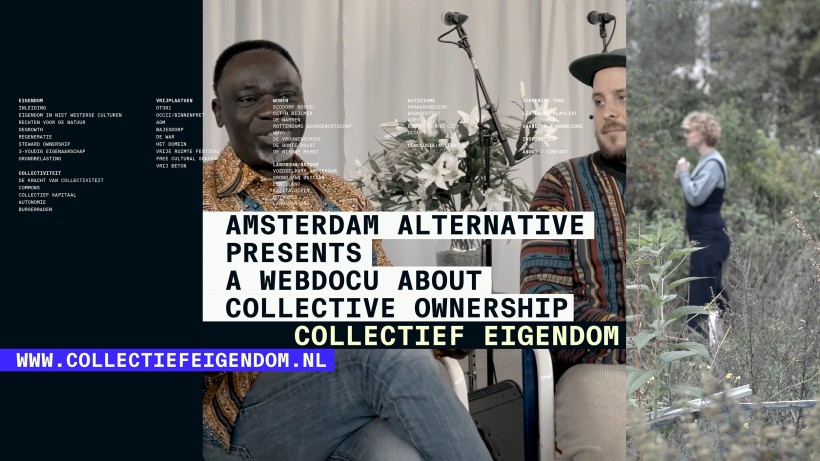
In 2022 and 2023, I was primarily engaged in creating a web documentary about collective ownership. This is a very extensive multimedia project that I worked on with great pleasure, as it closely aligns with my interests and ambitions — both in terms of content and the combination of media (text, video, photography, and audio).

In 2022, I took the initiative for this large-scale multimedia project myself and, under the name of Amsterdam Alternative, applied for funding from the Stimuleringsfonds Creatieve Industrie and the AFK. After the grants were awarded, I started working on the design of the web documentary, but especially on coordination and assembling a team


Web documentary on collective ownership

In 2022 and 2023, I was primarily engaged in creating a web documentary about collective ownership. This is a very extensive multimedia project that I worked on with great pleasure, as it closely aligns with my interests and ambitions — both in terms of content and the combination of media (text, video, photography, and audio).

In 2022, I took the initiative for this large-scale multimedia project myself and, under the name of Amsterdam Alternative, applied for funding from the Stimuleringsfonds Creatieve Industrie and the AFK. After the grants were awarded, I started working on the design of the web documentary, but especially on coordination and assembling a team of writers, researchers, translators, photographers, camera operators, sound designers, and more.

In total, around 60 people contributed to the project. At the end of 2023, we went live with a first (test) version of the project via a soft launch. In January 2024, the second version went online and we began promotion. The web documentary was built as a modular (expandable) project, and I hope to continue working on it in the coming years to further expand and improve it.

More detailed information about the project can be found on this page, or visit the web documentary itself at www.collectiefeigendom.nl

Several interviews and in-depth reviews of the web documentary have already been published by, among others, Design Digger (Jeroen Junte), Metropolis M (Joram Kraaijeveld), and Archined (René Boer). In 2024, the project was also nominated for a Dutch Creativity Award by the ADCN in the category “Next Impact.”


She is Coool

She is Coool is an international community by and for female, innovative designers and entrepreneurs, founded by Carolien Ligtenberg. By jointly creating a portfolio and setting up their own agency, the initiative aims to increase visibility, create new challenges, and generate collective impact.

Approximately half of the world’s population consists of women, yet their voices and potential are still often unheard or underutilized. She is Coool is committed to strengthening female influence through design, art, nature, architecture, and social design.
She is Coool is a network, community, and platform for like-minded women who—both individually and collectively—want to make the world a better and healthier place. By sharing knowledge, experience, and inspiration, brands, organizations, and governments are encouraged to make greater use of female potential.
Version 1.0 of She is Coool has been online for some time, but the platform is still under development. Designing and building a community platform with overlapping functionalities, as well as new features that distinguish it from social media, has proven to be an interesting challenge.
I designed the identity and website/platform for She is Coool and continue to collaborate with Joes (UseMedia), Yu-ann, and Carolien to improve functionality, strategy, and user experience.
View the website here.


The Dyke

The Dyke is a web documentary featuring stories about the social impact of the Afsluitdijk. This iconic dike — visible from the moon — has protected and connected the Netherlands for ninety years. It is now being reinforced, raised, widened, and prepared for the future.

The Dyke is a multimedia project about the future of the Netherlands — a country that would long since have ceased to exist without dikes. It is also a country that is increasingly aware that future challenges go beyond simply building stronger dams and dikes. A quarter of the Netherlands lies below sea level, and as much as three-quarters of the country could flood due to water from the sea or rivers. While sea levels are expected to rise by around three meters over the next century, the land itself is subsiding.

In the stories of The Dyke, you meet both well-known and lesser-known changemakers working on solutions for the future — from researchers at the world’s first blue energy power station to a close-knit Frisian community taking the lead in the energy transition. What does the renovation of the dike mean for an ecologist in Friesland? And how does the next generation think about climate adaptation? The stories are diverse and spread across the Netherlands, but they all have one thing in common: they begin at the dike.

The Dyke is an initiative by Cynthia Boll and Stephanie Bakker. The design was created by Kummer & Herman. I was involved as a video editor and motion designer for much of the video content in the web documentary.
View the web documentary here.


Bam! Popauteurs

Bam! Popauteurs is the largest interest group for artists, songwriters, and producers of pop music, hip hop, and dance in the Netherlands. It represents songwriters across all pop genres, from dance and hip hop to reggae and rock.

Members of the association receive free legal advice on contracts, agreements, deals, and music rights such as copyright. Bam! also provides free support for grant applications and organizes writing camps, facilitates participation in (international) courses and sync camps, partners in artist residency projects in Berlin and Poland, and hosts various member events each year featuring inspiring speakers and discussions.

I designed the logo, visual identity, various invitations and flyers, and the website for Bam! Popauteurs. At a later stage, I also created the “#Respectthecreators,” “Zo moet het zijn” (“This Is How It Should Be”), and “Make Streaming Fairer” campaigns.