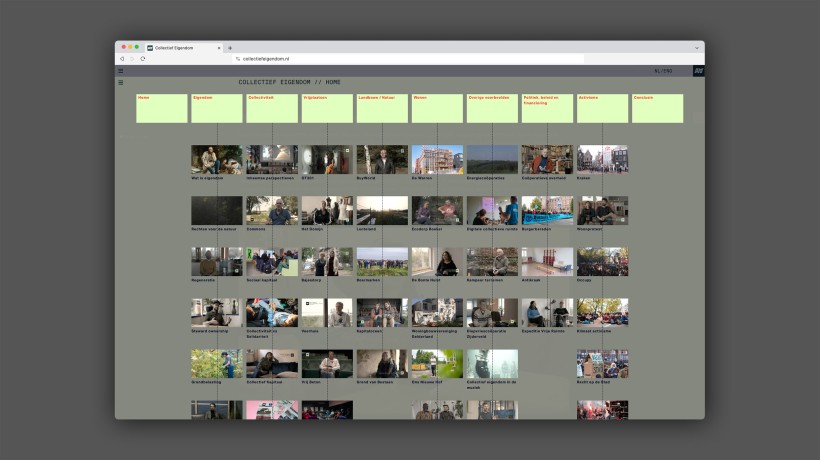
An online source of inspiration, archive, and practical guide in one
When I initiated Vrij Beton in 2019 (under the umbrella of Amsterdam Alternative) to work toward the realization of new free spaces (in collective ownership), I assumed that everyone knew what collective ownership was and how it worked. After an online and offline campaign to introduce the project to a wider audience, I organized several public discussions to involve interested and curious people in this ambitious project.
I quickly noticed that many people did not actually know how collective ownership works and often confused it with communism. Instead of continuing with Vrij Beton, I decided it would be wiser to first create a foundation in the form of an archive or knowledge base — a place I could refer people to when it became clear that they lacked knowledge about collective ownership. Because there are so many inspiring stories and examples, I decided to turn it into an expandable web documentary.
The result is a project in which video, audio, photography, and text are combined to bring knowledge together and make it freely accessible to a broad audience. The web documentary has been online since early 2024 at www.collectiveownership.net
Web documentary
Collectiefeigendom.nl is a collection of educational and hopeful stories, as well as explorations of alternative ways of organizing society. The main subject of this web documentary is collective ownership (non-profit), but it also addresses related topics that connect to our struggle for a fairer and better society for everyone.
I chose a web documentary rather than a “traditional” documentary for several reasons. The first and most important reason is depth. A traditional documentary has a clear beginning and end and usually lasts no more than two hours. Within that timeframe, everything has to be told, which means that many beautiful interviews and source materials are heavily edited. Editing often means losing valuable material and showing things out of context.
In this web documentary, we present both short edits and full-length interviews. As a viewer, you decide how deeply you want to dive in and how much material you want to watch, listen to, and/or read.
The second reason for choosing the web documentary format is its ongoing expandability. A traditional documentary is finished at some point and then remains unchanged. This modular web documentary is an open system: richly filled at launch, but always with the possibility to grow through the addition of many more inspiring stories.
A third advantage is accessibility. The web documentary is simply online and therefore accessible to anyone with an internet connection. There are no cinemas, licenses, tickets, or other barriers that limit access or viewing.
The fourth reason is the use of multiple media formats: video, audio, photography, and text. You can read, listen, and watch. This combination is interesting because each medium is experienced and consumed differently. Watching a video, for example, is more passive than reading, but it can be done together with others, while listening works well when traveling. In this way, we hope to reach a broad audience.
Video’s
The web documentary is a multimedia project in which video, audio, text, and photography are combined to bring together the inspiring stories of people and organizations working with collective ownership.
Almost all interviews for this project were recorded on video and preserved in their full-length versions. One of the strengths of a web documentary is that it allows for layered storytelling and the storage of large amounts of information for those who want to go deeper. We deliberately chose to publish the full-length versions of all interviews online, thereby building a true archive of shared knowledge and experience.
Currently, around 45 long video interviews (25–50 minutes per video) are available online, and this number is likely to grow in the future, as the project was intentionally designed to be expandable. In addition to the long interviews, there are also short versions and thematic summaries (ownership, collectivity, free spaces, housing, etc.). In total, approximately 40 hours of video content are currently available online.
As an additional feature, we built a screening tool into the web documentary. This page contains a complete list of all videos included in the project. The videos can be dragged into the player in any order, allowing visitors to compile their own custom documentary.
Webdocu soft launch event
At the end of September 2023, after one and a half years of work, version 1.0 of the web documentary was launched at the Ventilator cinema in OT301. This was a “soft launch,” as we were not entirely finished, but far enough along to go online and allow early visitors to explore the vast project.
To celebrate the launch of this special project, we organized an event at OT301 on September 30. From 15:00 hrs to midnight, there was a continuous screening of video material from the web documentary in the Ventilator cinema. In the Ventilator bar, several live podcast recordings and a small exhibition took place.
The live podcast recordings featured conversations with David (Kapitaloceen), Harsono (De Nieuwe Meent), Chandar (De Warren), Eline (Lenteland), Sofie (Regeneratie Coöperatie), and myself. These recordings can be listened to online.
We closed the evening with a party from 22:00 to 03:00 hrs in the club space downstairs, with music by Alberta Balsam (live), DJ Overdose, Kimmah, and Zgjim.
Envisioning Free Space Conference
On Friday, January 19, 2024, we organized a full evening program at OT301 about collective ownership as part of the Envisioning Free Space Conference. Just before this presentation, the second version of the web documentary was published. This version was much more complete than the one launched in September and marked the official start of our promotional efforts.
I opened the evening with an extensive presentation. While navigating through the web documentary on a large screen, I explained how the project came about, what can be found within it, and why collective ownership is a highly practical and important approach in the transition toward a fairer, healthier, and more pleasant world for everyone.
After my presentation, there were two short introductions: one by Jan Geurtsen about VrijCoop, and one by myself about Vrij Beton. These introductions were intended primarily as inspiration and to demonstrate that there are organizations that do not view collective ownership of housing and free spaces merely at an individual or project level, but are instead focused on developing scalable structures and methods to spread the concept more broadly.
This was followed by a public discussion on the value of collective ownership for free spaces, moderated by Jaap Draaisma. Participants included Eva Schippers (PlantageDok), Merel Kamp (Het Domijn), Marije Baalman (Bajesdorp), and myself (OT301, Amsterdam Alternative).
In a second panel discussion, the topic was explored in even greater depth through the lens of two places that are not yet in collective ownership but aspire to be. Participants in this discussion included Nico Redeker (De Fik), Kiek Korevaar (ZZW Rafelrand), and myself.
Interviews / awards
Creating this web documentary was a substantial undertaking that occupied me for more than two years. It is a fantastic project in which many of my ambitions and interests — design, video, writing, free spaces, collective ownership, activism — come together. However, creating something does not automatically mean it will be widely seen, so continuous promotion is necessary to bring the project to people’s attention.
Fortunately, after its launch, the project was widely shared by contributors and interviewees through websites, social media, and newsletters. The number of unique visitors has since grown to approximately 5,000 per month. Special thanks go to Jeroen Junte for his interview on Design Digger, René Boer for his in-depth review on Archined, Joram Kraaijeveld for his interview on the Metropolis M website, and De Appel for the extensive presentation and the opportunity to organize a seminar on collective ownership.
I hope that many more people—newspapers, websites, podcasts, radio, TV, blogs, and magazines—will pay attention to the web documentary. I am therefore generally available for interviews, presentations, workshops, and similar activities.
Another pleasant surprise was the project’s nomination for the ADCN Dutch Creativity Awards in the category “Next Impact.” Unfortunately, we did not win, but any attention for the project and its subject matter is more than welcome—not for me personally, but to further spread the ideas promoted through this project.
Future / ambition
The web documentary is already online, but as mentioned, it is a modular system designed to be expanded with new knowledge, experiences, and inspiring stories. At the moment, work is underway on subtitling all videos so that people who do not speak Dutch can also watch and listen.
We aim to reach as many people as possible — not to collect clicks or likes, but because we are convinced that collective ownership can play an important role in the transition toward a better, healthier, and more pleasant world for everyone.
This web documentary mainly focuses on the Netherlands, both because there are many inspiring projects and stories to be found here and because we lacked the resources to work internationally. Of course, there are also countless inspiring stories beyond the Dutch borders—in France, Germany, Switzerland, Spain, the United States, Japan, Brazil, Mexico, and many other countries. All over the world, people are organizing themselves collectively in ways that are not based on endless growth, profit maximization, and the exploitation of people and nature.
I hope to secure the financial means in the near future to develop a second version of this web documentary featuring a collection of international stories. Another ambition is to develop an educational project based on this subject. I believe it is important to make people aware—at as young an age as possible—of the importance of collectivity, solidarity, and the fair organization of ownership structures and society. Where better to start than in education?
Thanks
Special thanks for the realization of this project go not only to all those involved (writers, translators, sound designers, camera crew, interviewees), but also to AFK and the Stimuleringsfonds Creatieve Industrie, who believed in this project and provided funding. After completion, we also received financial support from Stichting DOEN and Rabobank to make the video subtitles possible.